
.png)
Pledge Perfect
JPMorganChase
End-to-end UX design for BIC Pledging Review Solution, converting a fragmented multi-system, multi-screen manual loan pledging workflow into a single AI-powered interface.
Featured Project
Reading Time: ~4 minutes
Current Status: Live (In Production)
My Role
-
Owned end-to-end product design lifecycle, from discovery and research through information architecture, interaction design, visual design, wireframing, prototyping, proof-of-concepts, design handoff, adoption monitoring, and continuous experience optimization
-
Defined and scaled AI experience principles, and reusable interaction patterns
-
Designed human-in-the-loop AI experiences incorporating explainability, confidence indicators, auditability, and user feedback mechanisms to improve trust, transparency, and consistency
-
Contributed to design systems, interaction guidelines, microinteraction patterns, motion graphics, accessibility standards (WCAG), and enterprise UX frameworks
-
Facilitated cross-functional workshops, design sprints, and collaborative working sessions with Product, Engineering, Risk, Operations, and Data/AI/ML teams
-
Championed adoption of AI-assisted decision-support workflows while balancing user experience, regulatory compliance, operational efficiency, and stakeholder expectations
-
Led usability studies, design critiques, and iterative validation exercises, leveraging qualitative and quantitative insights to continuously refine product experiences
-
Influenced senior stakeholders through storytelling, strategic thinking, design rationale, and data-driven recommendations, helping drive alignment and product investment decisions
-
Mentored designers and design excellence through knowledge sharing, design reviews, and establishment of best practices
-
Operated successfully as both an Individual Contributor and Design Leader, contributing across visual and interaction design, design systems, product strategy, and organizational design maturity.
Project Outcomes
The solution is now live in production and actively utilized by the BIC Pledging Center of Excellence (COE). Building on this success, our core AI architecture and User Experience has been extended to the Financial Spreading use case, resulting in a new solution now deployed with the Spreading COE in Commercial Investment Banking.
This deployment validates a scalable, domain-agnostic AI pattern that is paving the way for enterprise-wide expansion into additional lending workflows.
.png)
80% Faster
Reduced pledging review from ~90 minutes to about 18 minutes per loan

$ 2.5 Billions
Increased throughput capacity, Enabled processing outstanding loans

~94% Accuracy
Sustained over 6 months in production with automated drift monitoring

85% Adoption
Over 60 days,
Remaining 15% being transition-period users
Note: This page provides a high-level overview of my role and the outcomes delivered; detailed problem framing, process, and design decisions rationale are intentionally reserved for in-depth discussion.
Project Overview
Pledge Perfect is an AI-powered decision-support platform designed to transform the loan pledging review process within Commercial & Investment Banking.
The project reimagined a fragmented, multi-system workflow into a unified, human-in-the-loop AI experience, enabling faster, scalable, and more trustworthy decision-making in a highly regulated environment.
The Problem
Loan pledging review was:
-
Spread across multiple disconnected systems
-
Required manual document interpretation
-
Involved repetitive eligibility checks
-
Created high cognitive load
-
Was time-intensive (~90 mins per loan)
At the same time:
-
Accuracy was non-negotiable
-
Decisions needed auditability and compliance
-
Any automation had to maintain user trust
Design Challenge
How might we:
-
Reduce processing time without compromising accuracy
-
Make the workflow scalable and efficient
-
Introduce AI while ensuring trust, transparency, and control
-
Support regulatory compliance and auditability
Design Exploration
Early Exploration: AI Assistant / Conversational UI
We initially explored a fully autonomous AI model: AI reads documents → interprets → makes decisions → outputs results
The initial idea looked promising because it ensured maximum automation, minimal user effort, and faster loan processing.
But it failed! User research revealed that users did not trust black-box decisions, needed control over outputs, visibility into reasoning, and they wanted audit trails for compliance and future reference for informed decision making.
Insight
In regulated environments, trust > automation. Users don’t just need answers. They need to understand, verify, and control those answers.
Final Approach: Human-in-the-Loop AI
I pivoted to a decision-support system, not decision replacement.
3 Core Principles implemented :
-
AI assists, humans decide
-
Transparency over automation
-
Confidence over speed alone
Solution Design
Unified Workflow Experience
-
Consolidated multi-system process into a single interface
-
Reduced context switching and cognitive load
AI-Assisted Decision Layer
-
AI extracts and suggests key insights
-
Highlights eligibility conditions automatically
Explainability & Trust
-
Citation-based outputs (linked to source documents)
-
Confidence scores for each recommendation
-
Clear reasoning behind AI decisions
User Control & Flexibility
-
Editable AI outputs
-
Side-by-side comparison with original documents
-
Manual override capabilities
Auditability & Compliance
-
Full decision traceability
-
Transparent audit logs
-
Designed for regulatory review
Fail-Safe Mechanisms
-
Flags low-confidence scenarios
-
Encourages human validation when needed
Scaling the Impact
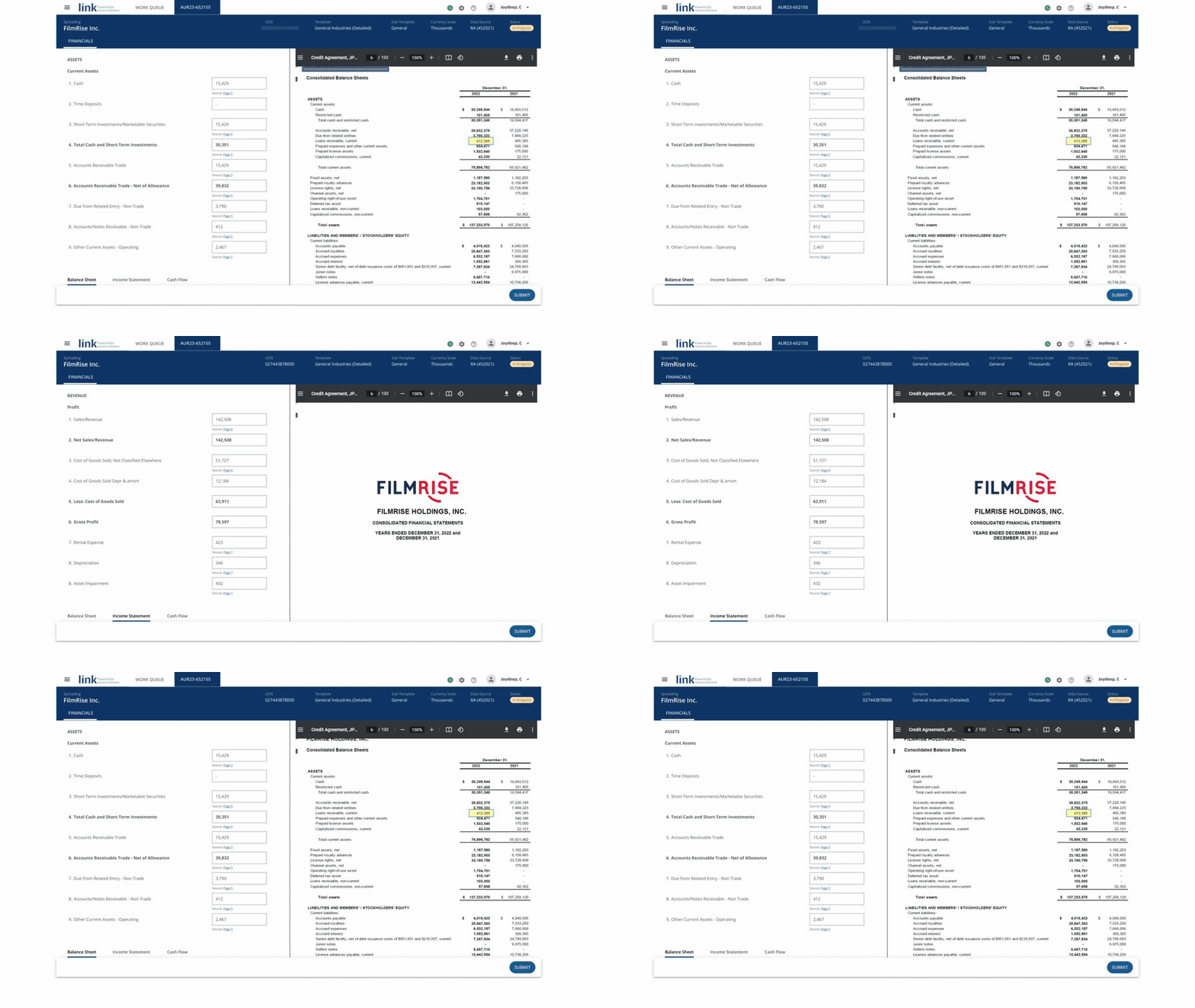
The biggest win wasn’t just the product, it was the pattern. This was later extended to Financial Spreading use case and broader CIB workflows. I helped to create a reusable framework for AI explainability, Human-AI collaboration, and Decision-support workflows.
Financial Spreading Interface
Failure and Learning
Not all early explorations worked. The agentic approach was one of the most promising ideas initially, but it failed to gain support once tested against real user expectations. That became an important learning moment: in enterprise workflows, advanced AI is only valuable when it fits the mental model of the user.
We also learned that transparency mattered more than automation. Users were far more comfortable with AI when they could see references, understand the reasoning, and intervene when needed. That insight shaped not just the BIC solution, but later influenced how we approached similar AI-driven workflows.
.png)


.png)


.png)

.png)
